Showing posts with label Monastery. Show all posts

Wednesday, December 11, 2024

The Buddhist Monastery Chimi Lhakhang in Bhutan and why Couples who want to have a Child make a Pilgrimage there


Lam Drukpa Kuenley (1455-1529) was an enlightened Buddhist master who knew the true Vajrayana tradition, also known as crazy wisdom [1]. His followers have also called him the divine madman because of his unconventional and sometimes outrageous form of teaching. He wandered around like a vagabond [2], enjoying song and dance, alcohol and women, hunting and partying. In reality, this only meant that he acted beyond all norms and conventions of human society. But he was also a social critic and performed sacred acts with which he freed afflicted Bhutanese from a number of male and female demons. Now followers come from all corners of the world to escape their cycle of negative karma. Something similar can be read in front of the monastery precinct, from where a short trek starts up hill.


Chimi Lhakhang or Chime Lhakhang is located on a hill near the village of Lobesa in Bhutan [3]. The temple and monastery were built in 1499 by Ngawang Choegyel after Drukpa Kunley (Tibetan: འབྲུག་པཀུན་ལེགས་) had built a chörten there. He is also the founder of the tradition of paintings of male sexual organs on the walls of houses, which are supposed to ensure the blessing of children. The wooden original of the phallus that Drukpa Kunley brought from Tibet is kept here in the monastery. The erect sexual organ has also been intended to drive away the evil eye and malicious gossip. More about this and also about the furnishings and construction of the temple can be found in the Wikipedia article.

Women who want to have children are touched on the head by the presiding lama with an ivory, wood and bone phallus. We were told in the monastery, however, that the women then have to walk three times around the monastery clockwise with the phallus. There are plenty of happy couples from all over the world who have sent photos of their babies and these can be seen in albums.


Drukpa Kunley "was known for his crazy methods of enlightening other beings, mostly women, which earned him the title "The Saint of 5,000 Women". Among other things, women would seek his blessing in the form of sexual intercourse." [4] I don't want to quote any more here because I didn't find it myself, but you can read the article on Wikipedia.

In the village below the monastery, which is also part of Lobesa, you can see a change from agriculture to tourism. The town is full of shops selling thangkas, souvenirs and especially phalluses of all sizes and designs.

I deliberately formulated things carefully and tried to choose my images wisely so as not to be blocked by puritanical blog and platform operators.


Links and Annotations:
[1] This first paragraph quotes and condenses from an information board set up by th Tourism Council of Bhutan near the Monastery.
[2] Reminding me of Han Shan (
寒山, Japanese Kanzan), his ame mean "Cold Mountain". Han Shan is a vagabond poet of the Tang () period, who wandered through the woods, laughed a lot, meditated in nature, and wrote poems on rocks and trees. He was closely associated with the Guo Qing Monastery / Temple (国清寺). The monastery dates back to the 6th century and still exists today.
[3] https://en.wikipedia.org/wiki/Chimi_Lhakhang  
[4] https://en.wikipedia.org/wiki/Drukpa_Kunley

.

Wednesday, September 14, 2022

Mongolia - Erdene Khambiin Khiid or Erdene Khamba Monastery in Khogno Khan National Park


There is little reliable information about the Erdene Khamba Monastery or Erdene Khambiin Khiid (Эрдэнэ хамбын хийд), also known as Ovgon-Khiid (Өвгон хийд), and certainly there is no entry on Wikipedia [1]. The remains of the monastery are located at the foot of the Khögnö Khan Mountains and belong to the Khogno Khan National Park (Хөгнө Хан) [2], about 60 km east of Kharkhorin (Хархорин) or 240 km west of Ulaanbaatar. It makes sense to look at this site on Google Maps, look up the link [3], because only a few buildings have been rebuilt, some ruins can be visited and you can also see the foundations of other buildings. The main monastery was supposed to be in another valley, but I couldn't find any foundations there. To the east and south-east are ger camps across the hills and then very large areas of agricultural land.


Zanabazar had the monastery built in honor of his teacher, the Lama Erdene. I don't think Lama Erdene was also the eponym for Erdene Zuu (Эрдэнэ Зуу хийд; own topic). Öndör Gegeen Zanabazar (өндөр гэгээн Занабазар) lived from 1635 to 1723 and was the religious leader of Lamaism, more specifically of the Gelugpa (Yellow Hat) lineage of Tibetan Buddhism in Mongolia [4], and he also has been the secular leader. Zanabazar is known for his bronze sculptures or the development of the Soyombo script [5]; overall he was a prodigious sculptor, painter, architect, poet, costume designer, scholar and linguist. Zanabazar did not want to submit to the Manchu, so a war broke out in which this monastery, like others, was destroyed in 1688. So far the older history. It was rebuilt and monks lived there again. In 1937, as part of Stalinist purges, the monastery was destroyed again and 20 monks were executed.


However, one of the lay monks survived and, before his death, made his wife promise to rebuild the monastery. Wife, then daughter and now granddaughter have taken this promise seriously and repaired some buildings. They did it with great affection and attention to detail. Erdene Khamba Monastery had two sections: the lower one called the Zaluu Khiid (Залуу хийд), and the upper one called the Ovgun Khiid (Өвгон хийд) [6]. Both can be visited and photographed inside. The path to the upper section is steep and to say it requires a little mountaineering experience is more than the German „schrittsicher“ means. It's worth while getting there, but be careful where you put your feet.


Links and Annotations:
[1] As of 14.09.2022!
[2] https://en.wikipedia.org/wiki/Khogno_Khan_National_Park
[3] https://www.google.de/maps/search/Khogno-Khan/@47.4259295,103.6947647,625m/data=!3m1!1e3
[4] https://en.wikipedia.org/wiki/Zanabazar  
[5] https://en.wikipedia.org/wiki/Soyombo_script You can see the script on the Mongolian flag.
[6] http://www.touristinfocenter.mn/en/cate1_more.aspx?ItemID=72


.

Thursday, September 1, 2022

Mongolia – Gandan or better Gandantegchinlen Monastery in Ulaanbaatar Part 2


Let's come to the second part of my visit to Gandan (Гандан) Monastery or better Gandantegchinlen (Гандантэгчинлэн хийд) Monastery in Ulaanbaatar [1], which is dedicated to the area, where one can look at the monumental statue of Avalokiteshvara.

Open lights are only permitted in an extra building

Inside the temple there are more prayer wheels


The tall Avalokiteshvara temple (Мэгжид Жанрайсиг Сүм) had been build in 1913 [2]. It houses the 26.5-meter-high statue of Avalokiteshvara, also called Janraisig. However, this temple had already been founded in 1727 by the 4th Emperor of the Qing (清代) dynasty, Yongzhen (雍正) , one of the sons of Emperor Kangxi (康熙) [3]. The original statue has been dismantled in 1938. The new statue has been erected in 1996 and this was possible due to donations by the Mongolian people. The statue featured more than 2,000 precious stones and is gilded with gold leaf.


Janraisig's body is filled with samples of crops,a variety of foods and drinks, medicinal herbs, juniper, Buddhist teachings, rare Buddhist clothing, and a book with 2 million mantras, and much more [4].

The small figurines at the walls are also worth looking at


Links and Annotations:
[1] Here's to look for the first part: https://rheumatologe.blogspot.com/2022/09/mongolia-gandan-or-better.html
[2] https://de.wikipedia.org/wiki/Gandan-Kloster
[3] A still important dictionary is named after Kangxi and I already quoted it this year: https://rheumatologe.blogspot.com/2022/07/seit-wann-wird-tee-in-china-getrunken.html and also here, where there's also a picture of the cover: https://rheumatologe.blogspot.com/2022/04/tee-und-einige-aspekte-aus-sinologie.html (both text in German, however).
[4] https://peak.mn/news/megjid-janraisig-burkhnii-tuukh Мэгжид Жанрайсиг бурхны түүх. Дэлхийн II дайны үед Мэгжид Жанрайсиг бурхныг буулгаж их биеийг нь Орос руу явуулж хайлуулан сум хийсэн байдаг.


.

Mongolia – Gandan or better Gandantegchinlen Monastery in Ulaanbaatar Part 1


Gandan (Гандан) Monastery or better Gandantegchinlen (Гандантэгчинлэн хийд) Monastery lies in Ulaanbaatar and has been rebuild during the past 30 years. „The Tibetan name translates to the "Great Place of Complete Joy". It currently has over 150 monks in residence. It features a 26.5-meter-high statue of Avalokiteśvara. It came under state protection in 1994.“ [1] Therefore I decided to split writing about Gandan Monastery in two parts – the first part is dedicated to the area of the medidation center and the morning ceremony and the second part is dedicated to the area, where one can look at the monumental statue of Avalokiteshvara.


The first temple of the monastery has been constructed in 1809 and if interested, check the Wikipedia article for more knowledge on the history of the buildings. Important aer the 1930ies, when quite a lot of the sacral building have been destroyed and 15,000 lamas had been killed (the number still is uncertain). After the fall of the Soviet Union and end of Marxist rule in Mongolia in 1990, worship was possible again, monasteries were rebuild the statue of Avalokiteshvara has been reconstructed, and the monks came back.


I was very surprised looking at the two monks blowing the shell as a call for the morning ceremony. I had watched this in Tikse (Thiksay) in Ladakh [2], which looked more colorful and impressive, but non the less it gave a touch of both sincerity and tradition to the Ulaanbaatar monastery. I could see the monks joking and bustling to the assembly hall, where they chanted sacred scripts, which are printed as in fomer times. I had seen this in Tibet at Narthang Monastery [3].


One observation: I've seen a lesser number of prayer wheels than in Tibet or Ladakh.


.

Saturday, August 27, 2022

Mongolia – the mysterious 100 Stupas of Erdene Zuu Monastery


„The Erdene Zuu Monastery (Mongolian: Эрдэнэ Зуу хийд, Chinese:光顯寺, Tibetan:ལྷུན་གྲུབ་བདེ་ཆེན་གླིང་) is probably the earliest surviving Buddhist monastery in Mongolia.“ [1] I guess that's a good reason to visit this monastery while in Mongolia, especially if you visit Kharkhorin. Said and done. And then the guide talked about the 100 stupas on the surrounding walls. I asked her, why not 108 stupas as this is the holy number in Buddhism and I thought if you have the money for 100, you probably have enough money for the remaining 8 stupas. Stupid as I was, I didn't count the stupas, which would have been a task by itself as each wall is 400 m long, but let myself mullify when we went outside again to see the remains of ancient Karakorum, which made it possible to see two stupas at each corner. 100 + (4x2) = 108. QED!

Also seen in Pucha's book from a different angle


After I returned to Germany, I looked at a Google Map image of Erdene Zuu Monastery and counted the stupas on the walls. Well there are only 92 stupas on the four walls. My guide-book says 102 stupas [2]. Now, 92 + (4x2) = 100. So we're back to the number, the guide originally quoted [3]. I leafed through a book by Pavel Poucha [4]. Poucha gives 108 plus 8 – he obviously didn't count, though I must ask: could he count at all, because he visited the monastery in 1955 and tells us: „In 1940 almost everything was destroyed here.“ And: „The whole complex of Erdenitso is now managed by only three people, the guard and his family, who have a beautiful and clean yurt in the monastery courtyard.” So,  Pavel Poucha's honour is restored; he has been a czech orientalist, mongolist as well as indologist, who taught at the renowned Charles University in Prague [5].


The authors of the Wikipedia entry quote a German source [6] and think that planners wanted 108 stupas, but only realised 100. 
 
Prayer wheel

Abtai Sain Khan ordered the construction of the monastery in 1585 after meeting the 3rd Dalai Lama. In 1688 the monastery had been damaged and abandoned, but had been rebuild in the 18th century. There lived about a 1000 monks in 1872. During 1939 (not 1940) the monastery was destroyed and monks were killed by the communists. And it's quite strange to read that Stalin pressured the Mongolian communists to maintain the monastery as a showpiece for international visitors [1]. And it must have been much in this state as Pavel Poucha has seen Erdene Zuu Monastery. 


Today much has been restored. Lamas with affiliation to the Gelug sect of Tibetan Buddhism have returned. Erdene Zuu Monastery is an active place of worship and also a museum.


When you return to the outer world again, you find yourself in a kind of county fair, directed at local and foreign tourists. You can watch and feel sorry for the eagles [7]. You can watch people taking their photographs in historical costumes, which I have seen also in Tibet and elsewhere.


Links and Annotations:
[1] https://en.wikipedia.org/wiki/Erdene_Zuu_Monastery
[2] Michael Walther und Peter Woeste: Mongolei. DuMont Reise-Handbuch. Dumont Reiseverlag, Ostfildern 2019. ISBN-10:  ‎3770181417. P. 301.
[3] Never doubt your guide! Nonsense, always doubt, but try to get proof later.
[4] Pavel Poucha: 13000 Kilometer durch die Mongolei. VEB F.A. Brockhaus, Leipzig 1960. P.  201.
[5] https://cs.wikipedia.org/wiki/Pavel_Poucha Pavel Poucha (1905-1986). He started with studyin Sanskrit, Hindi, Bengali, Hebrew, Turkish and Persian. Interestingsly he had been removed from his position because of political reasons in 1957, but kept on publishing non the less. There's also an entry in Mongolian on Pavel poucha: https://mn.wikipedia.org/wiki/%D0%9F%D0%B0%D0%B2%D0%B5%D0%BB_%D0%9F%D0%BE%D1%83%D1%85%D0%B0
[6] „Niels Gutschow, Andreas Brandt, Die Baugeschichte der Klosteranlage von Erdeni Joo (Erdenezuu), in Claudius Müller (ed.), Dschingis Khan und seine Erben, Bonn 2005, p.353“ - quoted from [1].
[7] Nobody will understand you if you sing „Hotel California“.

.

Wednesday, October 31, 2012

Antoniyevo-Siysky Monastery (Антониево-Сийский монастырь)


It isn’t easy to get to Antoniyevo-Siysky Monastery (Антониево-Сийский монастырь); only pilgrims usually venture to go there. Why would one go there and what are the difficulties?

The monastery is quite old; it has been founded in 1520. About a century later the father of Michael, first Romanov tsar (цар Михаил Романов), Fyodor Nikitich Romanov (Феодор Никитич Романов) had been exiled in this monastery. So this is an historic spot.

The monastery lies quite close to the M8 and has an easy access, if you have a car. The monastery is about 150 km South of Arkhangelsk and you don’t have public transport. It isn’t easy to rent a car in Arkhangelsk and I’ll tell later, how we succeeded to rent a car. You can have a look at Google maps – here’s the link: https://maps.google.de/maps?q=63.55%C2%B0+N+41.55%C2%B0+E&hl=de&ie=UTF8&ll=63.553522,41.556129&spn=0.00538,0.01487&sll=64.533996,40.577273&sspn=0.010389,0.02974&t=h&z=16.

A winding road next to lakes took us to the gate of the monastery. We’ve seen a couple of perplexed monks as nobody expected tourists coming to the monastery with the holy trinity cathedral. The cathedral has been built on a peninsula of Mikhailovskoye Lake. I’ve read about 13 monks living there and 60 workers. The numbers might not be right, but give an impression. There’s lots of work still to be done to counteract, what time and times have been doing to the buildings. The cloister has been reopened in 1992; before it served different purposes. The last (current?) abbot’s (Архимандриты) name is Varlaam (Варлаам Дульский).

At unter http://siya.aonb.ru/index.php?num=512 you can find an old drawing and compare it with the pictures, I show here.

Coming near to the monastery 


Entering the yard of the monastery


In the yard of the monastery 

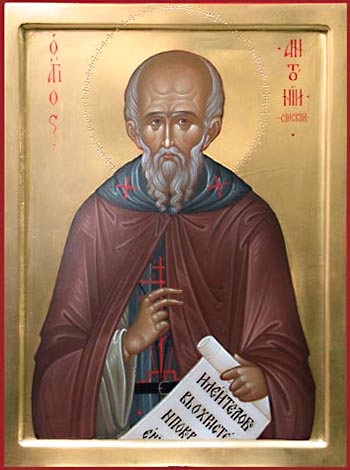
Grave of  Antoniyevo-Siysky (Антоний Сийский)

The only modern room one can see, shop for ikona
         
Ikona of Antoniyevo-Siysky/ Прп. Антоний Сийский, современная икона:


You may compare my picture with this link: http://www.sedmitza.ru/data/860/481/1234/10898.jpg
Antoniyevo-Siysky Monastery (Антониево-Сийский монастырь) during Winter http://www.360cities.net/de/image/siya-1-8000#-233.80,26.31,88.1  


Related links for this travel:
On changing Moldovan Lei in Odessa
http://rheumatologe.blogspot.de/2012/10/on-changing-moldovan-lei-in-odessa.html  
The Very Basic Guide to Russian http://rheumatologe.blogspot.de/2012/10/the-very-basic-guide-to-russian.html  
Crime and Punishment (St. Petersburg) http://rheumatologe.blogspot.de/2012/10/crime-and-punishment.html  
Hram Ilias – the hidden silence near the Red Place in Moscow http://rheumatologe.blogspot.de/2012/10/hram-ilias-hidden-silence-near-red.html  
Kishinev – the prologue of this year’s travels http://rheumatologe.blogspot.de/2012/10/kishinev-prologue-of-this-years-travels.html